 Call: (740) 815-2629


- Central Ohio
Serving all of Central Ohio and the surrounding areas, residential and commercial.
- Licensed & Insured
Free estimates on every project, big or small. Call or text (740) 815-2629.
 Central Ohio
 Licensed & Insured
Drainage & Culverts in Central Ohio
Standing water, a soggy yard, roof water running down along the foundation, a drive that sags over the ditch: it is all water that needs a way out. We dig it a path, lay the pipe and the stone, and leave the ground graded and seeded.
We handle the whole job: drains across the yard, downspouts piped away from the house, and the culvert where your drive crosses the ditch.
French Drains, Downspouts and Catch Basins

Sometimes the slope can't do it all. A flat lot with nowhere downhill to send the water, or ground that stays soggy all year, needs the water taken underground.
A French drain is a trench with perforated pipe laid in stone, often wrapped in fabric, that carries the water by gravity to an outlet: a ditch, a catch basin or a spot downhill. A catch basin is a box with a grate at a low spot, tied to solid pipe. Underground downspouts carry the roof water away from the foundation the same way, and we have been putting a lot of them in.
The pipe has to keep falling all the way to the outlet, so the outlet often sets the depth. On one yard that stayed soggy year-round, we laid three legs of perforated drain tile and ran a solid outlet line to a catch basin. On another property with ongoing water problems, the drain ran right along the house to protect the foundation. On a storm water install, we laid 350 feet of 4 inch SDR 35 pipe and tied it into an existing system.
Swales, Riprap and Erosion Control
Not every water problem sits next to the house. A swale is a shallow channel that carries surface water around a house or barn and on to a place where it can leave. Riprap is large stone lining a ditch or a swale so moving water can't wash it out. On one job we built a new gravel driveway along with a riprap drainage swale to control the runoff.
Bare ground washes out. Once the grade is set, seed and straw hold the topsoil until the grass comes in, and stone lines the spots where the water runs hardest, like the end of a swale. Where the water ends up is part of the plan: somewhere it can drain, never onto a neighbor's lot. When the shape of the yard itself is the problem, that is grading.
Do I Need a Driveway Culvert?
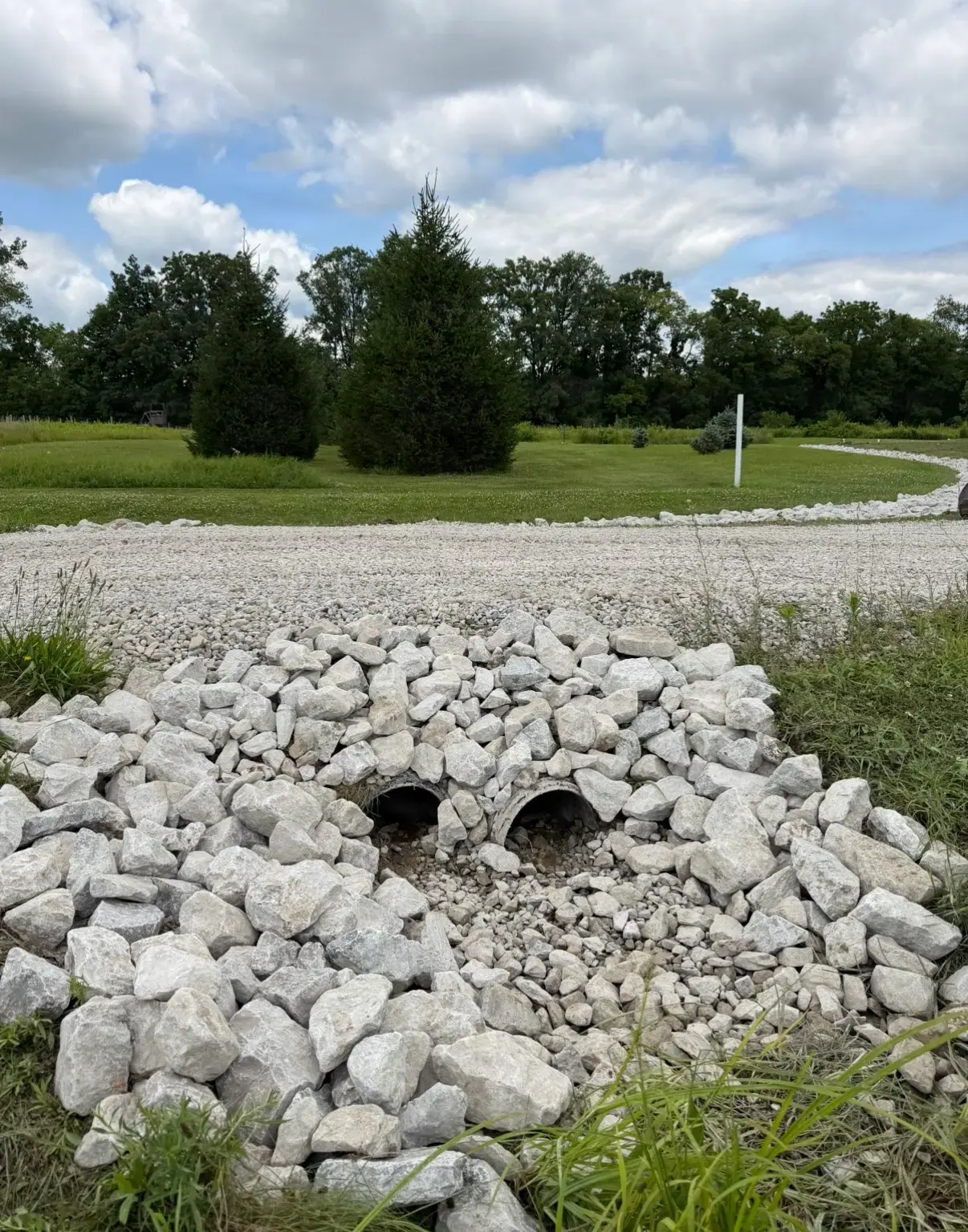
If your drive crosses a ditch, almost always. Many country roads here drain through open ditches, and a drive that crosses one needs a pipe under it so the water can keep going. A new home or pole barn on a country lot usually means a new drive, and a new drive over a ditch means a new culvert.
Our heavy clay subsoil makes that pipe work hard. Clay doesn't soak much rain in, so in a wet spring the ditches run full. A pipe that is too small, or half full of silt, backs that water up onto the yard or sends it over the drive.
Signs Your Culvert Is Failing
As we like to say, "A good culvert isn't something you think about until it fails." Look for these before it does:
- A sag or a hole in the drive over the pipe
- Water backing up on the high side, or running over the drive in a storm
- A rusted-out or crushed pipe end
- A washed-out ditch at the outlet
Freeze-thaw winters make it worse. Water that gets around a broken pipe freezes, lifts the stone, thaws and carries fill away, and the hole grows from underneath.
How We Install or Replace a Culvert
On one recent job, an old, decayed culvert under a driveway crossing had started to fail. We removed the failing pipe, installed a brand-new culvert and rebuilt the crossing so it drains properly and holds up for the long haul.
We set the new pipe in line with the ditch and with its fall, shooting grade with a laser level so the water runs through instead of sitting in the pipe. Soft, wet clay under it may need to come out first, and if it does, we tell you on the spot. The backfill goes in around the pipe in layers, each one compacted, and the ends get stone so the ditch doesn't wash out.
“Bryson worked on a culvert replacement and a large extension of a driveway approach for a property of ours. He did an amazing job and worked really hard to get the job done right.”
Jamie L., Facebook recommendation
That crossing passed the township's inspection. The stone over the pipe is the start of the drive, and we finish that part too: a new gravel driveway, or the old one reworked and topped with fresh limestone.
Culvert Rules in Delaware County
For drives on county and township roads, the Delaware County Engineer sets the rules. The smallest drive pipe it allows is 12 inches across, and its rule reads "Minimum pipe length will be 30' (plastic, metal) or 32' (concrete)". The county adds that "Two inspections are necessary for all open ditch roads." Inside a city or village, that place's rule applies instead.
Every drain and culvert job is digging, and Ohio law has underground utility lines marked before any digging: call 811.
We serve yards and country drives from Sunbury to Johnstown and across Central Ohio, and we are licensed and insured.
Water Where It Shouldn't Be?
Call or text (740) 815-2629 for a free estimate.
Photos From Our Jobs
Every photo here is from one of our own jobs. Tap one to see it bigger.


Questions We Hear a Lot

-
It depends on the job: how far the water has to go and how deep the pipe has to sit, the size and length of a culvert pipe, whether an old pipe has to come out, the ground, the stone and access for the machines. Call or text (740) 815-2629 for a free estimate.
-
Clay is where a drain is needed most: water can't soak down through it, so the drain gives it a path out. The trench, the stone and the fall to the outlet are set for the ground we find when we dig.
-
Yes. We run the downspouts into solid pipe underground and carry the roof water away from the foundation to a spot where it can drain.
-
Long enough to reach past both edges of the drive with the side slopes laid back, so the ends don't wash out. On county and township roads in Delaware County, the county engineer sets a minimum length by pipe material; inside a city or village, that place's rule applies.
-
Usually, yes. We dig out the crossing over the old pipe, take the failing pipe out, set the new one and rebuild the crossing on top, then blend the stone into the rest of the drive.
-
Yes. Estimates are free. Call or text (740) 815-2629, or send the form on our contact page, and tell us about the job (photos help).
Ready to Get Started?
Call or text Deim’s Dirt Works at (740) 815-2629 for a free estimate.
-
- Service Area All of Central Ohio
& surrounding areas - Free Estimates Call or text usLicensed & insured
- Find Us Online


